
Discover
Questions library
Collections library
Find online teacher
login
Discover
questions library
Find online teacher
login
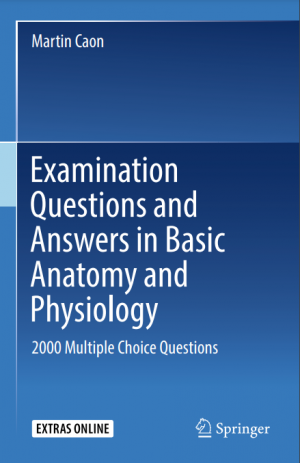
Examination Questions and Answers in Basic Anatomy and Physiology
by
Martin Caon
Edition:
ISBN13:
978-981-10-2332-3
ISBN10:
1878
Medicine
Home
Books
Examination Questions and Answers in Basic Anatomy and Physiology
Similar Books
No books found
Title
Chapter: 12.5 /
Q: 17
If a person has an arterial blood pressure measurement of 16 kPa (120 mmHg), this equates to which of the following pressures in newtons per square centimetre?
Chapter: 12.5 /
Q: 18
An intravenous (IV) infusion flows into a vein because of hydrostatic pressure. This depends LEAST on which of the following?
Chapter: 12.5 /
Q: 19
Due to an atheromatous plaque, a man’s coronary artery has narrowed to one third of its healthy diameter, all other things being equal, his blood flow rate (ml/min) in that artery would
Chapter: 12.5 /
Q: 20
According to Poiseuille’s law, volume flow rate through a blood vessel is proportional to its radius to the fourth power (V ∝ R4 ). If an atheroma reduces the radius of an artery from 4 mm to 2 mm, what effect would this have on the blood flow through the artery?
Chapter: 12.5 /
Q: 21
Say a diastolic blood pressure reading was 80 mm Hg. This is consistent with which one of the following statements?
Chapter: 12.5 /
Q: 22
If mean arterial pressure is kept constant while a small artery changes its radius from 1 mm to 2 mm, what will happen?
Chapter: 12.5 /
Q: 23
Complete the following sentence. When standing, the arterial blood pressure in the feet is:
Chapter: 12.5 /
Q: 24
When “colloid osmotic pressure” is used in relation to the blood. What is being referred to?
Chapter: 12.5 /
Q: 25
According to Poiseuille’s law of fluid flow, the volume flow rate, V, is proportional to radius to the fourth power. What would happen to the volume flow rate of blood if the diameter of an artery decreased to 20 % (1/5) of its original diameter? V would:
Chapter: 12.5 /
Q: 26
If the blood pressure at the arterial end of a blood capillary is 4000 Pa (30 mmHg) and at the venule end of the capillary is 2000 Pa (15 mmHg), and the capillary has a length of 1 mm, what will the pressure gradient in the capillary be?
total questions:
1878
Previous
106
107
108
109
110
Next
Questions
1878
Views
Best Answers
299
Points
5
×
Close
add reason
reason