
Discover
Questions library
Collections library
Find online teacher
login
Discover
questions library
Find online teacher
login
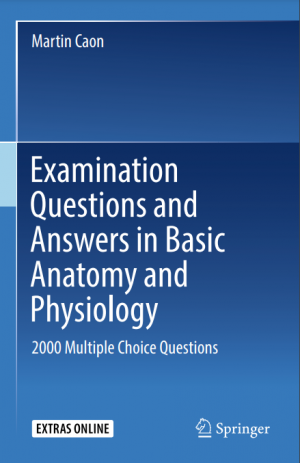
Examination Questions and Answers in Basic Anatomy and Physiology
by
Martin Caon
Edition:
ISBN13:
978-981-10-2332-3
ISBN10:
1878
Medicine
Home
Books
Examination Questions and Answers in Basic Anatomy and Physiology
Similar Books
No books found
Title
Chapter: 12.5 /
Q: 7
What is a normal pressure in the venous system returning blood to the heart?
Chapter: 12.5 /
Q: 8
The intravenous cannula that will give the largest flow rate is:
Chapter: 12.5 /
Q: 9
Consider Pascal’s principle. If the heart exerts a pressure of 120 mmHg on the blood in the aorta, where else in the body will the blood pressure be 120 mm Hg?
Chapter: 12.5 /
Q: 10
If an atheroma reduces the diameter of an artery from 2 mm to 1 mm, what effect would this have on the blood flow through the artery? (According to Poiseuille’s law, volume flow rate through a blood vessel is proportional to its radius to the fourth power i.e. V ∝ R4 )
Chapter: 12.5 /
Q: 11
If the radius of a blood vessel is halved, the blood flow through it drops to one sixteenth its previous value. This statement could be describing which of the following?
Chapter: 12.5 /
Q: 12
A man who is standing has a resting systolic blood pressure of 120 mmHg at the start of his aorta. What will be the pressure in the arteries of his feet?
Chapter: 12.5 /
Q: 13
To what does the term “cardiac output” refer?
Chapter: 12.5 /
Q: 14
A resting blood pressure stated as 120/80 (in units of mmHg) refers to
Chapter: 12.5 /
Q: 15
Which of the following does NOT influence the resistance to blood flow?
Chapter: 12.5 /
Q: 16
Colloid osmotic pressure
total questions:
1878
Previous
105
106
107
108
109
Next
Questions
1878
Views
Best Answers
299
Points
5
×
Close
add reason
reason