
Discover
Questions library
Collections library
Find online teacher
login
Discover
questions library
Find online teacher
login
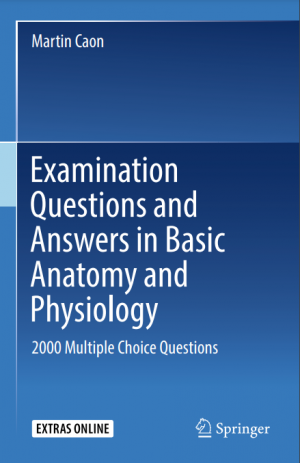
Examination Questions and Answers in Basic Anatomy and Physiology
by
Martin Caon
Edition:
ISBN13:
978-981-10-2332-3
ISBN10:
1878
Medicine
Home
Books
Examination Questions and Answers in Basic Anatomy and Physiology
Similar Books
No books found
Title
Chapter: 12.4 /
Q: 14
Which of the following is a statement of Boyle’s law?
Chapter: 12.4 /
Q: 15
In which of the following situations would the greatest pressure be produced?
Chapter: 12.4 /
Q: 16
Using “suction” to drain fluid is described correctly by which choice below? Creating a:
Chapter: 12.4 /
Q: 17
Pressure is a quantity derived from force and the area in contact with the force. What is it that pressure measures?
Chapter: 12.4 /
Q: 18
Which of the following is NOT used as a unit of pressure?
Chapter: 12.4 /
Q: 19
When performing cardio-pulmonary resuscitation (CPR) why do you use the “heel” of the hand rather than the whole palm and fingers?
Chapter: 12.4 /
Q: 20
Which choice correctly completes the sentence? Pressure is a:
Chapter: 12.4 /
Q: 21
If a blood pressure is stated as 120 over 80 (in units of mm Hg) this means:
Chapter: 12.4 /
Q: 22
The pressure, P, exerted by an intravenous infusion of saline at the level of the cannula must be great enough to overcome the venous blood pressure in the vein. It’s magnitude is given by: P = 10 × 1000 kg/m3 × head of liquid (in m), where 1000 kg/m3 is the density of saline?
Chapter: 12.4 /
Q: 23
Which of these statements about pressure in static liquids is NOT true? Pressure at a point in a liquid
total questions:
1878
Previous
101
102
103
104
105
Next
Questions
1878
Views
Best Answers
299
Points
5
×
Close
add reason
reason